
EuroPCR 2026: From Evidence to Treatment Decisions in Interventional Cardiology
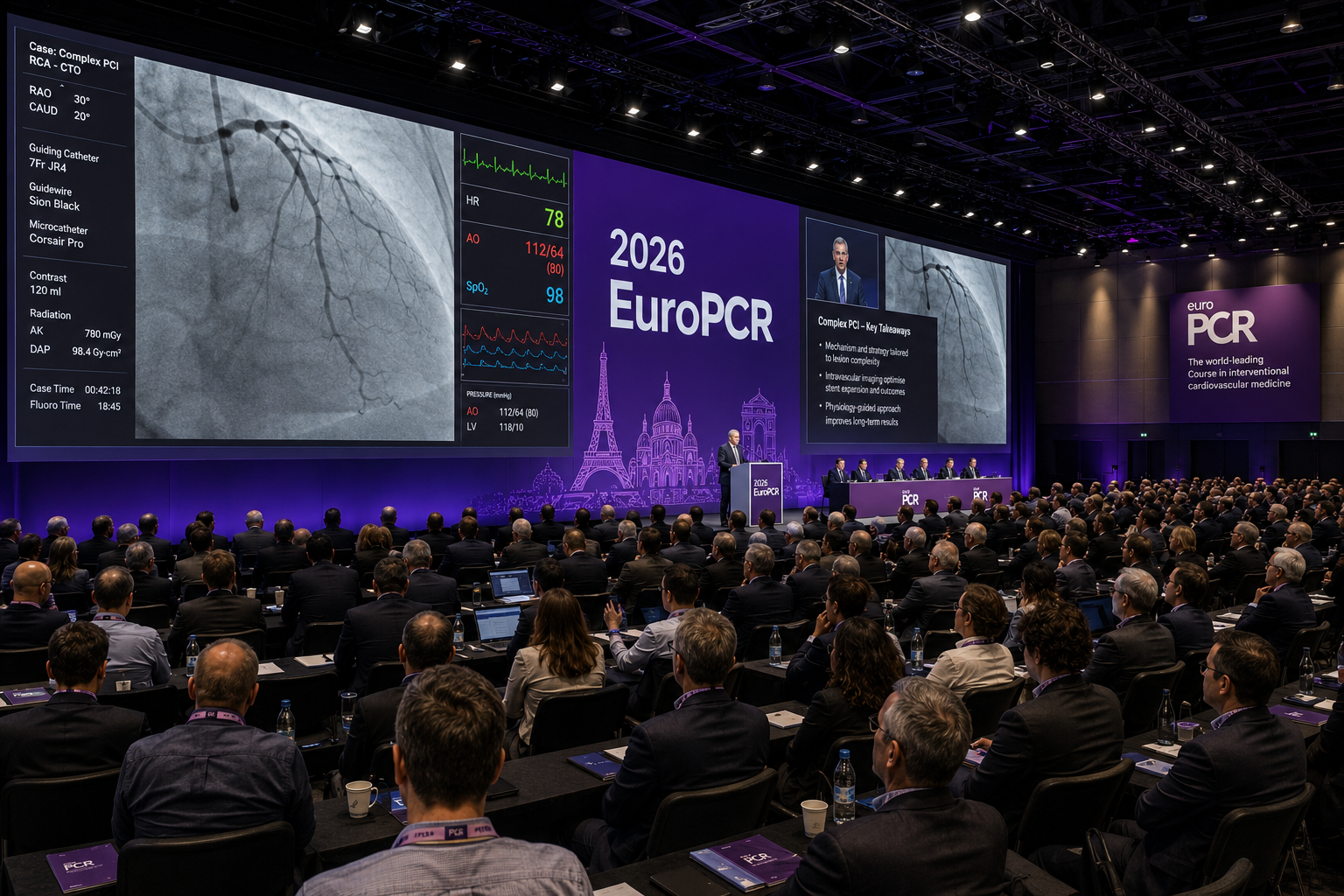
EuroPCR is the leading international course and congress in interventional cardiovascular medicine, held annually in Paris, and focused on how clinical evidence translates into procedural and treatment decisions. The 2026 programme continues to centre on complex coronary and structural heart disease, with structured learning formats spanning live cases, imaging, physiology, and outcomes-driven decision-making.
The core value of EuroPCR has remained consistent: aligning rapidly evolving evidence with how clinicians make treatment decisions in real patients — particularly in coronary artery disease, where the choice between PCI, CABG, and medical therapy remains complex.
What the 2026 programme reflects in practice
Across sessions and case-based tracks, EuroPCR 2026 continues to emphasize:
- Complex PCI and CTO strategies in increasingly high-risk patients
- Revascularization decision-making in multivessel and left main disease
- Integration of intravascular imaging and physiology into routine practice
- Structural heart interventions and expanding transcatheter indications
- Outcomes-focused interpretation of comparative trial data
- AI and digital tools positioned around workflow and decision support rather than standalone innovation
The consistent thread is not procedural novelty, but how clinicians interpret competing evidence under uncertainty.
The practical constraint: decisions are still fragmented
Despite advances in imaging, devices, and clinical trials, real-world coronary decision-making remains fragmented:
- Evidence is distributed across trials, registries, and guidelines
- Risk assessment and treatment selection still varies inconsistently across similar patients
- Long-term outcomes are not routinely synthesized at the point of decision
The result is variability not in technical capability, but in how treatment choices are constructed from available data.

Where the field is moving
Across EuroPCR, one underlying shift is increasingly visible:
Interventional cardiology is moving from procedure-centric evaluation toward treatment-strategy evaluation over time.
That includes:
- Comparing outcomes across entire care pathways involving multidisciplinary teams rather than single interventions
- Incorporating patient-level risk into treatment selection more explicitly
- Moving beyond anatomical assessment toward longitudinal outcome expectation
This shift is most evident in complex coronary disease, where the "best" option is rarely procedural alone, but context-dependent across time.
Where Revaz fits in this shift
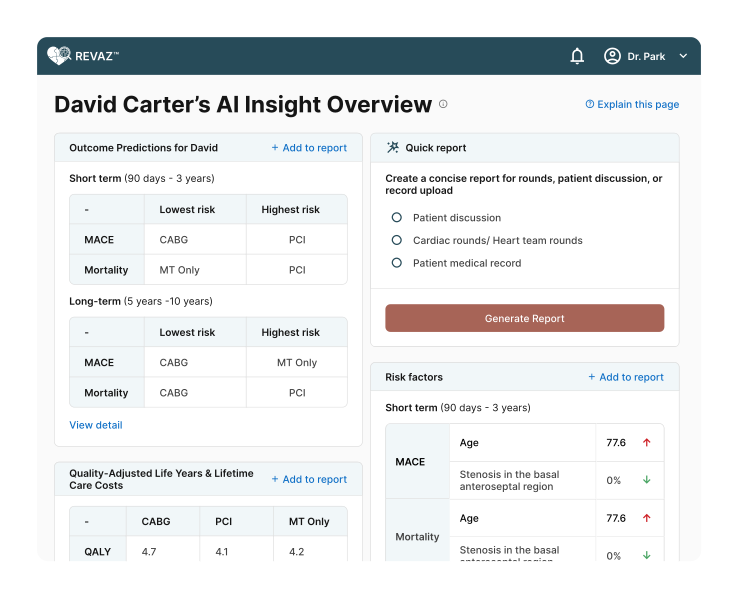
Revaz, a novel clinical decision-support tool built by Symbiotic AI, is built for this decision layer.
Rather than focusing on procedural guidance alone, Revaz structures longitudinal, treatment-comparative outcomes intelligence in coronary artery disease, enabling:
- Direct comparison of PCI, CABG, and medical therapy outcomes with patient-specific risk stratification across time horizons
- Structured synthesis of clinical variables into interpretable profiles
- Consistent framing of treatment trade-offs for multidisciplinary teams
The objective is not to replace clinical judgment, but to reduce variability in how evidence is assembled at the point of decision.
Follow Revaz at EuroPCR 2026